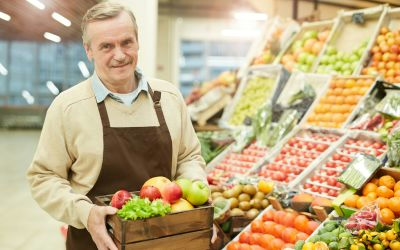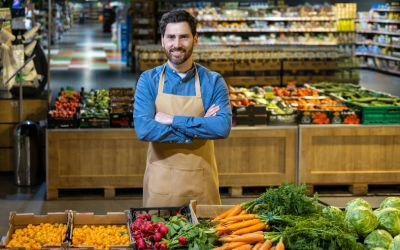



If you’re buying food in volume, the choices you make directly affect your bottom line. It’s not just about picking the cheapest option — it’s about choosing stock that fits how your kitchen works, holds up under pressure and stays consistent across service.
For many businesses, the decision between fresh and frozen food is still an open question. Fresh sounds like the obvious choice. But when you look at the practical side — shelf life, storage, waste, prep time — frozen starts to make more sense.
Let’s look at what matters when you’re buying in bulk — and why frozen food is now a first choice for so many kitchens.
Contents
- 1 1. A Longer Shelf Life Means Less Stress
- 2 2. Predictable Prices and Consistent Supply
- 3 3. Freezers Are Easier to Work With Than Fridges
- 4 4. Less Waste, Better Planning
- 5 5. No Prep? No Problem.
- 6 6. Quality You Can Count On
- 7 7. Still a Place for Fresh — But Use It Smartly
- 8 8. Who’s Actually Using Frozen?
- 9 Get Ahead of the Curve — Not Caught Behind It
1. A Longer Shelf Life Means Less Stress
Fresh stock moves quickly. That’s fine if you’re ordering daily and prepping on the fly. But most businesses don’t work like that — and a short shelf life leads to stress, waste and second-guessing your order volumes.
Frozen food gives you space to breathe. Whether it’s frozen fruit, frozen vegetables or frozen meat, the product is stable, reliable and usable on your schedule — not the other way around.
There’s no rush to use it by Friday. No guessing how long it’ll last. Just stock you can depend on, ready when you are.
2. Predictable Prices and Consistent Supply
Fresh prices change constantly. If your supplier is reacting to the weather, availability or fuel costs, so are you. That makes it hard to stick to a budget, especially when you’re buying in bulk.
Frozen products are different. They’re processed and packed in high volumes, stored in controlled conditions and priced to reflect stable supply chains. This gives you consistency in cost and quality, all year round.
That’s a major plus when you’re ordering frozen meat for batch meals or using frozen vegetables across rotating menus. You know what to expect and you’re not caught off guard by sudden price jumps.
3. Freezers Are Easier to Work With Than Fridges
Most businesses don’t have room to spare. Fresh produce takes up a lot of space and often needs careful handling to avoid bruising or spoilage. Stack too much and you’re left with damaged stock and mess.
Freezers are easier to manage. Items like frozen fruit or frozen vegetables come sealed, stackable and space-efficient. You can fit more in. You can store it longer. And you don’t need to reorganise the fridge every morning.
It’s a simpler setup — especially for businesses with shared storage, rotating teams or limited back-of-house space.
4. Less Waste, Better Planning
It’s not just the food that gets wasted when fresh stock goes off — it’s your time, your money and your menu. Over-order and you’re binning the product. Under-order and you’re rushing to make up the gap.
Frozen reduces that pressure. You take what you need, when you need it. If plans change, no problem — it goes back in the freezer.
That flexibility supports better planning. If you’re running a school kitchen, a café or a canteen, knowing your stock won’t spoil between deliveries makes a real difference.
5. No Prep? No Problem.
Time spent peeling, slicing and portioning adds up. And when you’re short on staff — or trying to keep service sharp — every shortcut helps.
Most frozen vegetables are prepped and ready to cook. Same with frozen fruit — no washing, no slicing, just open and use. Frozen meat often comes portioned too, cutting down on mess and saving hours over the course of a week.
This isn’t about cutting corners. It’s about using time and resources better — so you can focus on service, not slicing carrots.
6. Quality You Can Count On
Fresh ingredients vary. Even from the same supplier, quality can shift week to week. That might not be a problem in small batches, but when you’re buying in bulk, inconsistency causes more work and more waste.
Frozen products are processed at peak condition and stored in a way that preserves them. You get a consistent product, with the same size, cut and texture — across every order.
If you’re building dishes around frozen meat or using frozen fruit in puddings and breakfast pots, that kind of consistency helps with portioning, costing and prep.
7. Still a Place for Fresh — But Use It Smartly
This isn’t about choosing one over the other forever. Fresh ingredients are still important, especially when appearance or raw presentation matters. Salads, herbs and garnish are better fresh, no question.
But for the backbone of your menu — hot meals, batch prep, long shelf life stock — frozen is often the better fit. Use fresh for what it does best. Use frozen to make everything else easier, faster and more reliable.
8. Who’s Actually Using Frozen?
A lot more businesses than you might think. Schools, cafés, hotels, leisure centres, care homes — anyone managing regular meals or large numbers of covers benefits from switching part of their order to frozen.
It’s not about volume for the sake of it. It’s about matching the food to the job. If you need consistency, shelf life, prep-time savings or all three, frozen food makes the day run smoother.
Get Ahead of the Curve — Not Caught Behind It
Food service is about working smart. And while fresh produce still has its place, there’s a reason so many businesses are building their menus around frozen vegetables, frozen fruit and frozen meat.
They’re cheaper to run. Easier to store. More reliable to cook with. And when you’re buying in bulk, those benefits add up fast.
At Mason Foodservice, we supply a wide range of frozen stock to kitchens across the Midlands. If you’re rethinking how you order — or want to get more from the space, staff and stock you’ve got — we can help.Looking for frozen food that actually works for your kitchen? Talk to Mason Foodservice or call 0116 271 9000 to get started.